
2027 National Speaker Forum
The Courage to Fight for Freedom
Featuring Pulitzer Prize-Winning Journalist and Author Julia Angwin
33rd Annual National Speaker Forum | April 6, 2027 | Memorial Hall
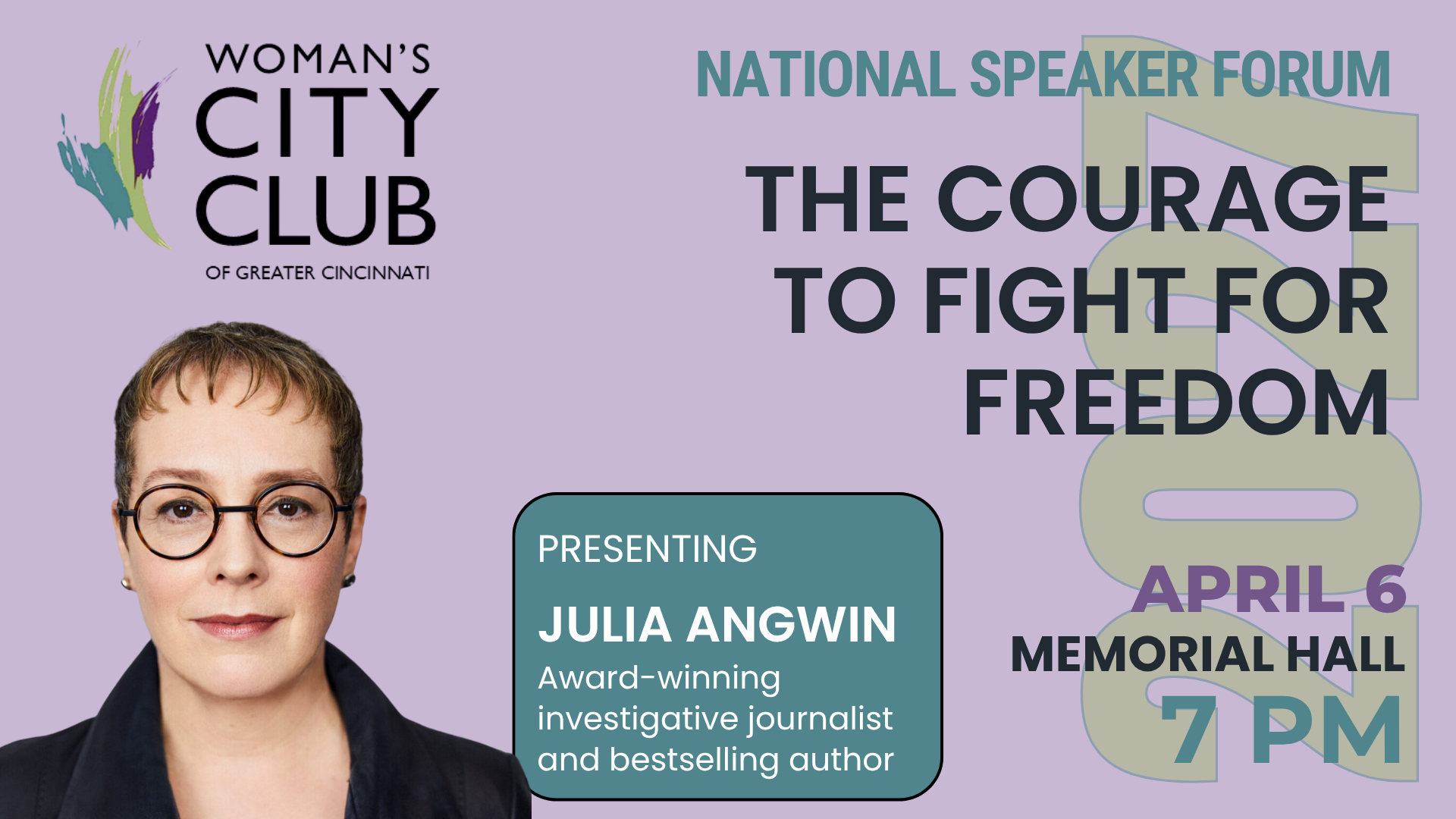
For more than three decades, the Woman’s City Club of Greater Cincinnati’s National Speaker Forum has brought nationally recognized voices to Cincinnati to inform, challenge, and inspire our community. In 2027, the tradition continues as the Woman’s City Club presents its 33rd Annual National Speaker Forum, featuring Pulitzer Prize-winning investigative journalist and bestselling author Julia Angwin.
In a presentation titled The Courage to Fight for Freedom, Angwin will draw from her newest book, On Courage: How to Be a Dissident in an Age of Fear, co-authored with Ami Fields-Meyer. Based on interviews with more than 100 dissidents, activists, and thinkers from around the world, On Courage explores what enables ordinary people to stand up for their beliefs, overcome fear, take meaningful risks, and defend the freedoms and institutions they value.
Through stories spanning countries, cultures, and generations, Angwin and Fields-Meyer examine the experiences of people who found themselves confronting powerful institutions or political systems—often without ever intending to become activists. Their stories offer lessons about courage, community, hope, preparation, and the choices individuals make when remaining silent becomes increasingly difficult.
At a moment when questions surrounding freedom, civic participation, technology, privacy, the power of institutions, and the health of democratic societies are commanding attention around the world, Angwin brings a perspective shaped by decades of investigating power and holding powerful institutions accountable.
About Julia Angwin
Julia Angwin is an award-winning investigative journalist, bestselling author, New York Times contributing Opinion writer, and a leading voice on technology, privacy, accountability, and the role of independent journalism in a democratic society.
Angwin began her career in journalism more than three decades ago and spent 13 years as a reporter at The Wall Street Journal. In 2003, she was part of a Journal reporting team awarded the Pulitzer Prize for Explanatory Reporting for its coverage of corporate corruption. She later led the newspaper’s groundbreaking privacy investigative team, whose work was named a Pulitzer Prize finalist in 2011 and received a Gerald Loeb Award.
She subsequently joined the nonprofit investigative newsroom ProPublica, where she led an investigative team examining technology, algorithms, privacy, and discrimination. That team was named a 2017 Pulitzer Prize finalist in Explanatory Reporting, and its work received a Gerald Loeb Award in 2018.
Angwin has also been an innovator in creating new models for independent investigative journalism. She founded The Markup, a nonprofit newsroom established to investigate how powerful technologies affect society, and later founded Proof News, a nonprofit journalism studio dedicated to producing rigorous, evidence-based investigations.
Today, she is the founding director of the Independent Media + Audience Project at Harvard Kennedy School’s Shorenstein Center on Media, Politics and Public Policy, where her work focuses on strengthening independent media and its relationship with the public.
Her previous books include the New York Times bestseller Dragnet Nation: A Quest for Privacy, Security and Freedom in a World of Relentless Surveillance and Stealing MySpace: The Battle to Control the Most Popular Website in America. Her newest book, On Courage: How to Be a Dissident in an Age of Fear, extends many of the questions that have defined her career: Who holds power? How is that power exercised? What happens when institutions fail to protect individual rights? And what can ordinary people do in response?
A Cincinnati Tradition of Conversation and Civic Engagement
The National Speaker Forum is a signature program of the Woman’s City Club and reflects the organization’s longstanding commitment to educating and empowering citizens to take an active role in civic life.
For 33 years, the Forum has provided Greater Cincinnati audiences with opportunities to hear directly from nationally prominent authors, journalists, advocates, scholars, and thought leaders addressing consequential issues of our time. More than a lecture, the Forum is intended to spark conversation, deepen understanding, and encourage participants to remain informed and engaged in their communities.
With The Courage to Fight for Freedom, the 2027 National Speaker Forum continues that tradition by inviting our community to consider an enduring civic question: What does courage require of each of us when the values and freedoms we care about are tested?
Join the Woman’s City Club and Julia Angwin for an evening of ideas, stories, reflection, and conversation—and an exploration of how individual acts of courage can contribute to stronger communities and a more resilient civic life.